Whilst looking for an old Hedgerow Nursery catalogue recently(unsuccessfully, I might add), I came across an old dog-eared catalogue entitled "A Book Of Roses". It was written by a lady named Judith Pfeiffer of Cloyne Nursery near Cooma, NSW, and in my early rose years it served as my rose 'bible'. Judith's rose descriptions were perfect...before the internet it was quite difficult to find accurate details regarding how any particular rose variety performed under Australian conditions. There were plenty of English or American rose books to be found, but my Australian rose book library hadn't started at that time, and finding Judith's beautifully written catalogue was a Godsend to a new rose gardener just starting out.
One of the most helpful sections of "A Book Of Roses" was a section at the back entitled "Roses For Difficult Positions". I am reproducing it here in my blog in the hope that it may guide other budding rosarians as it helped me so many years ago. Without further ado, here it is.....
"ROSES FOR DIFFICULT POSITIONS.
SHADE No roses will thrive in heavy shade of large trees, but many will perform well in partial shade. Of these, perhaps, the most tolerant as a class would be the Albas, closely followed by the Hybrid Musks, Rugosas and some Species Roses. The more robust of the Modern Shrubs, for example Lavender Lassie, Shropshire Lass, Fruhlingsgold and Fruhlingsmorgen will also give a good showing in partial shade.
For shady walls, with a southern aspect, Mermaid and Zephrine Drouhin will both flourish and flower very well, as will the tall Hybrid Musks Buff Beauty, Pax and Penelope. I am amazed at how much shade all these roses will take.
SANDY SOIL AND SEA AIR: The Rugosas should be your first choice for these conditions. They will grow on the sandy shores of Cape Cod and on the eastern shores of Japan, which is their original habitat. The true 'rugosa' is one of the hardiest and most disease resistant types which we possess. They will tolerate warm humid conditions as well as severe frosts.
ALKALINE SOILS: Roses do not like too much lime, but this problem can be overcome. they prefer a soil that is neutral or very slightly acid, so if your problem is alkalinity, and the foliage of the roses turns pale yellow-green, dig large quantities of humus into your soil, in the form of either compost, peat or horse or cow manure. Not sheep or fowl manure as this will add to the alkalinity. Heavy soils often lack phosphates. Sulphate of Potash is a good source of potash. Blood and Bone is an excellent natural source of phosphates.
ROSES FOR HEDGES, WINDBREAKS AND SCREENS.
I feel, in Australia, that roses are not used nearly enough for these very important elements in our gardens.
A great deal of thought and care is necessary to find the perfect rose for your needs, but if all factors are taken into consideration, your rose hedge or screen can be the highlight of your garden, and need not create a lot of extra work.
Of major importance is the height. Firstly we will consider the low dividing hedge within the garden. In my garden I have four such hedges, all very different in character, and all stunning in their own way. There is no doubt that when one makes a strong statement with one rose, the effect is brilliant.
Of major importance when choosing a rose for this purpose is its foliage. No matter how beautiful the flowers, the effect is straggly, unless the foliage is luxuriant and healthy, and equally important is the growth habit of the plant. It needs to be bushy and branchy from the ground. Tall spindly growth will never make a hedge.
Near the entrance of the nursery against a low stone wall I have planted 'Stanwell Perpetual'. This rose has pretty soft ferny foliage which seems to be almost disease free. Customers say the air is heavy with the fragrance of the soft pink flowers before they open the gate. The growth habit is fairly lax which suits the position as it cascades over the low wall. The roses are planted .75m apart to make a dense hedge.
I had a fairly large glass house that needed softening, but not shading, and so for this purpose I chose the soft, fluffy Ballerina, whose masses of pink and white single flowers, which appear continually in great clusters, have done the trick. This hedge I will keep to .90 m. I again planted the bushes .75 m apart. In front of this hedge I planted the Hybrid Dianthus 'Haytor's White'. It also flowers continually and the soft grey foliage is a great foil for the pink and white effect.
The third hedge is along a fence and here I have planted my much-loved 'Felicia'. A Hybrid Musk with very healthy foliage and clusters of large, very fragrant, pink double flowers, flowering throughout late Spring, Summer and Autumn. It grows to 1.2X 1.2 m, but can be kept to 1m if you so desire.
The last low growing hedge in my garden is one I have along the verandah where there is no guard rail or wall, so that when one sits on this much-used verandah, the roses are very much part of the scene. Here we planted the ever flowering Iceburg, with its beautiful shiny dark green foliage, a perfect foil for the creamy-white flowers. It has to be one of the most generous roses ever created. Planted about .90 m apart.
Hedges from 1.5-7m: In this range we look at proper barrier hedges for privacy, or hedges to be used in Canberra instead of a front fence, or to camouflage the ugly fences around swimming pools. Or to be used as windbreaks.
For this purpose one would have to first of all suggest the original Rugosa roses. They have wonderful dense growth from the ground up. the foliage is beautiful, tough and disease resistant as well as colouring brilliantly in autumn. The flowers are continuous and sweetly scented and as the final bonus, large round, bright red or orange hips. A truly impenetrable and fragrant hedge needing little more care than privet. Best varieties would be R. Rugosa Alba; Blanc Double de Coubert; Frau Dagmar Hastrup; R. Rugosa Rubra; R. Rugosa Typica; Scabrosa; Rosarie de L'Hay or Schneezwerg.
Very beautiful and very fragrant hedges can also be made with the hybrid musk roses. Use either one variety or mix two or three complementing varieties which grow to the same height. I have seen wonderful hedges made from Penelope, Felicia and Autumn Delight. I have also seen an enviable hedge of just Cornelia alone. These hedges will be flowering the first year and in that time will grow to 1m in height. The same may be said for the rugosas.
WINDBREAKS: For very large, tall screens and windbreaks, the Species roses cannot be beaten. They have great vigour and strength, need very little watering, are very free from disease and will reach amazing heights in a few years. There is no quicker way of getting a 20 ft high windbreak, and the only support they will need are some treated poles and 2 or 3 wires. Suitable varieties are Mermaid; R. Bracteata,; R. Eglanteria(Sweet Briar); R. Multiflora and its hybrids, to name a few.
ROSES FOR GROWING INTO TREES, SMOTHERING UNSIGHTLY FEATURES.
Alberic Barbier
R. Filipes Kiftsgate
Francis E. Lester
Clg. Cecile Brunner
Wedding Day
Banksia Lutea
ROSES FOR GROUND-COVER- VERY LOW GROWING GOOD FOR BANKS
Max Graf
Nozomi
Snow carpet
R. Wichuriana Hybrids
Felicite et Perpetue
Raubritter
12 OLD FASHIONED ROSE BUSHES SELECTED FOR THEIR CONTINUITY OF FLOWER.
Buff Beauty
Ballerina
Boule de Neige
Charmian
Dame Edith Helen
Charles Austin
Monsieur Tillier
Moonsprite
Penelope
Stanwell Perpetual
Souvenir de St. Ann
Seafoam
12 CLIMBERS SELECTED FOR THEIR CONTINUITY OF FLOWER
Altissimo
Buff Beauty
Blossomtime
Clair Matin
Crepuscule
Desprez a Fleur Jaune
Iceberg
Mermaid
Mme Abel Chatenay
New Dawn
Souvenir de la Malmaison
Titian
10 OLD FASHIONED BUSH ROSES CHOSEN FOR THEIR FRAGRANCE.
Alba Maxima
Celeste
Charles de Mills
Common Pink Moss
Gloire de Ducher
Mme Ernst Calvat
Mme Isaac Perrier
Mme Legras de St. germaine
Mme Pierre Oger
Mme Hardy
Roserie de :'Hay
EVERGREEN CLIMBERS
Mermaid
Wedding Day
Alberic Barbier
12 ROSES SELECTED FOR ALL ROUND PERFORMANCE- continuous flowering, good foliage, fragrance.
Charmian
Chaucer
Duchess de Brabant
George Arends
Gruss en Achen
Hero
Lady Mary Fitzwilliam
La Reine
Mme Caroline Testout
Mme Lauriol de Barney
Compte de Chambord
Mme Ernst Calvat
-Taken from "A Book Of Roses" by Judith Pfeiffer of Cloyne Nursery, Cooma. Obtained by me in February, 1995.
My tastes don't necessarily match those of Judith's, but then I have "weird" likes and dislikes in roses. For example, I am one of the few people I know who really doesn't take to Crepuscule, Albertine or even Mme Alfred Carriere or Lamarque. A list of favourite roses would never contain any of the Wichuriana ramblers- I am definitely a multiflora girl. Wichurianas have those creepy long, long arms that wind around everything, and horrid thorns, and I don't even like their blooms very much.
On the farm here there used to be an old Dorothy Perkins rose that climbed up an old wooden tankstand. Even when the tankstand was gone, Dorothy skulked around everywhere poking her nose in where it wasn't wanted. She was a magnet to powdery mildew, and I thought of her as being like a mean old spinster woman with a black, cold heart...needless to say, no tears were shed when she shuffled off the mortal coil.
 Above: David Austin's "John Clare". This rose is one of the most prolific bloomers of the Austin group, and one of my favourites. The colour is darker than in this photo..I was taking it with the sun shining directly behind the bloom. He has a nice shrubby habit, and his height and width depends on the position. This one jostles for space with the hybrid musks Eva and Kathleen, and so has grown quite tall. Another has plenty of space to spread, so he has grown wider than his height...about 1.5m x 2 m. The fragrance isn't too overwhelming...mild and sweet would probably be the most apt description.
 My fave...good old speccy Cymbeline! After a big Spring flush, it is already gearing up for a big Summer show.
 Above: 'Scepter'd Isle', another of the glorious myrrh-scented Austin roses. The blooms are large and very pretty, especially the way the yellow stamens are visible in the rose's centre. It develops into quite a largish shrub- about 2m x 1.5 m in this garden.
 Above: The twisty unique blooms of General Gallieni, a fabulous old Tea rose that flowers continuously throughout the year, even providing a few blooms through Winter. He is a rose that really marches to the beat of his own drum (like my favourite type of people)...every bloom seems to be different, and like all tea roses the colour can vary very much in response to the amount of sunlight that it receives. This bloom is from a plant that is in a very shady position, and the blooms on it are generally deeper in colour and contrast to the blooms of those General Gallienis that grow in more sunny aspects.
 Kew Rambler- what a brilliant rose! It starts flowering well after the other ramblers finish (with the exception of Francis E Lester, who is still putting up a show), and once it starts it just goes and goes and goes. Because of all the rain we have had over the past few weeks, botrytis has reared its spotty head in the garden, including on Kew Rambler. It doesn't really bother me, so I never spray for it. The only symptoms roses ever seem to display here are the little deep pink circles on the petals, which are not too detracting from the overall appearance.
 Above: This rose is a cracker...I just love it! It is David Austin's Brother Cadfael, and its scent and bloom formation are gorgeous. The blooms are big and full of petals and cupped like a chalice, perfect for a pointy nose like mine to burrow into and get to the centre of the fragrance. They totally smother the bush, and the repeat is excellent if snap deadheading is conducted. This particular Brother Cadfael was only planted this last Summer, in January or February, and so is only about a metre high so far. I have another more established plant, and it has developed into a shrub about 2m x 1.5 m.
 Above: David Austin's Eglantyne...an excellent 'workhorse' of the rose world, this rose puts out its pretty soft pink blooms continuously from Spring to Autumn, and grows into a largish shrub of about 2m x 2m. Like all Austins, it has a wonderful perfume (with, of course, the exception of 'The Reeve', which I still think smells of cat pee).
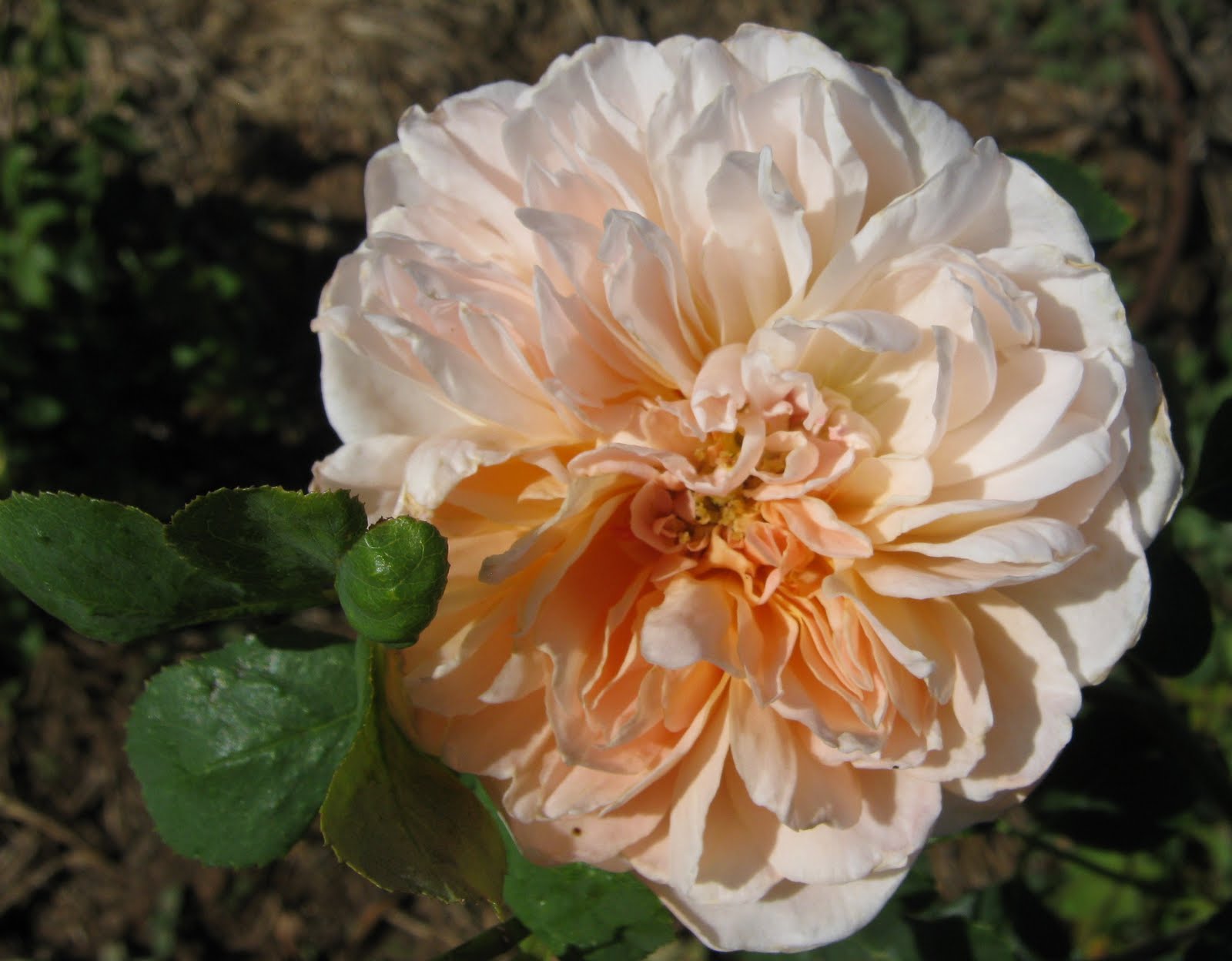 Above: David Austin's Tea Clipper. I have never grown this rose before, and have only had it in the garden since January 2011, so I can't as yet comment on its habit, but I can say that the blooms are lovely. Yesterday, when this photo was taken, this bloom was displaying the unusual effect of one half being decidedly lighter than the other..the bottom was an apricot, and the top a buff-gold. I have seen tea roses do this, but not an Austin.
 Above: There always seems to be a hybrid musk blooming somewhere in the garden, no matter what the time of year. This is Francesca's second flowering of the season. She flowers in profusion earlier than the other hybrid musks, and has a quick turn around before she's putting on a show again. I have mentioned before that Francesca tends to drop her leaves and look a bit ratty after the first big bloom of Spring, but this is not a problem with subsequent flowerings.


